
Nvidia's boss quit. Your pension felt 91p of it.
Jensen Huang left Nvidia after 33 years and the shares fell off a cliff. I did the maths on what that actually does to your pension, and it's less dramatic, and more useful, than the headlines.
The day the chair was empty
On Thursday 12 November 2026, Nvidia announced that Jensen Huang had resigned as president, chief executive and board member, after 33 years running the company. Four days earlier he had told staff he had been unfaithful to his wife. That is the only thing he has admitted.
The New York Times has reported, according to the BBC, that US officials suspect a woman linked to an Nvidia customer of working for Chinese intelligence. That is alleged, not proven. The US Attorney General said on 12 November that no conclusions had yet been drawn, and China calls the claim a smear. The New York Times also reported a relationship with an Nvidia employee, and Reuters later reported another, citing two unnamed people. Neither is confirmed by Mr Huang or by Nvidia.
None of that is the funny part, and none of it is the point of this. The point is what happened on the same day he left: Nvidia appointed its first-ever chair of the board. Thirty-three years, one boss, no chair, until the week it all came apart.
Sixty people, one phone number
About 60 people reported straight to Mr Huang, according to the Guardian; the BBC's technology editor says as many as 200. He still owns roughly 3.6% of the company. When he resigned, Nvidia's shares fell around 13% at the open and closed down 4.3%, wiping more than $180bn (£135bn) off its value in a single day.
The finance chief, Colette Kress, has stepped in as interim chief executive. That is the oldest fix in business: the second-in-command keeps the lights on while the board works out what comes next. It is also, almost exactly, what happened at Hewlett-Packard back in August 2010, when chief executive Mark Hurd resigned after an inquiry found inaccurate expense claims linked to a personal relationship with a contractor. HP's shares fell 9.7% in after-hours trading, its finance chief stepped up, and a month later Mr Hurd turned up as co-president of rival Oracle, prompting HP to sue over the move. Same shape, sixteen years apart: the shares drop first, then the worry turns to where the know-how goes.
The week the shares kept falling
It wasn't a one-day wobble. Nvidia's shares fell 13% that week, their sixth weekly fall in a row. By Friday 13 November they had lost around 30% of their value, roughly $1.7 trillion, since early October, according to CNBC. That figure needs a health warning: CNBC reports that investors had already turned gloomy before the scandal broke, over interest rates and the US election results, so the resignation did not cause that whole number on its own. Outlets even disagree on the scandal week itself: about $490bn by Thursday's close according to the Guardian, $550bn over five days according to the BBC, and about $600bn by the Guardian's later count.
By Monday 16 November, the shares had closed at $156.14, down 4.12% on the day, valuing Nvidia at about $3.76 trillion. An open letter asking the board to bring Mr Huang back had grown from 165,000 names to 180,000 over the weekend, Elon Musk among the signatories. Sources told both CNBC and the BBC that the board is not currently considering it. Nvidia's results are due tomorrow evening, with analysts forecasting sales of $108.9bn for the quarter, up 91% on a year earlier. That is a forecast, not a result, and this is not financial advice.
What this has to do with your business, or your pension
Strip away the headlines and you're left with two very ordinary business risks, both of which Nvidia had, despite being worth close to $3.76 trillion.
The first is key-person risk. Every small business has the one person who knows the passwords, the supplier terms, and which client hates being phoned before ten. If that person doesn't come in tomorrow, how much of the business actually stops? Nvidia had roughly 60 to 200 people reporting into one man, and no chair of the board until the week he left. Jason Hollands of Bestinvest told City AM on 10 November that the doubt over Mr Huang's position had brought key-person risk into sharp focus, and that even a tracker fund holding hundreds of companies can be surprisingly concentrated in a handful of names.
The second is one-supplier risk. The AI tools most businesses now rely on, from the chatbots staff use to the systems behind the scenes, are trained and run largely on chips designed by Nvidia. Microsoft, Meta and Google are all building their own chips to reduce that dependence. One company in Taiwan, TSMC, makes the overwhelming majority of Nvidia's chips in the first place. A single business can't fix that supply chain. It can know exactly which AI tools it depends on, and what it would do without any one of them for a week.
The typical dent, not the headline one
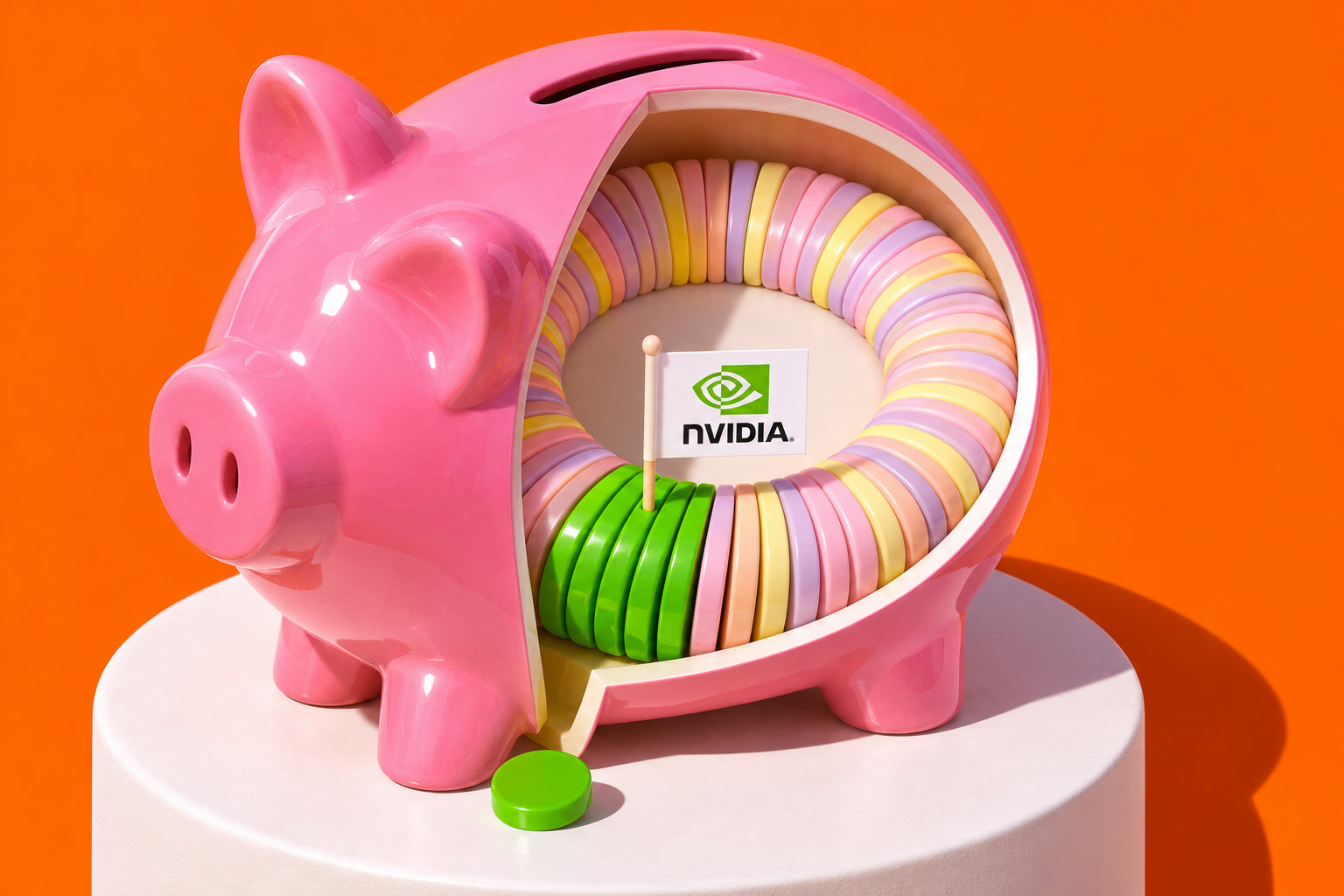
If you have a workplace pension or a US tracker fund, you very likely own a slice of Nvidia, and it is worth knowing roughly how big. Before the slide, Nvidia made up about 7% of the S&P 500, so about £7 of every £100 held in a typical US tracker. On rough sums using figures from the i Paper and CNBC, a 13% weekly fall in that slice works out at around 91p per £100, or about £91 on a £10,000 pot. In a workplace pension where roughly 45% sits in US shares, closer to £3 of every £100 is Nvidia, so the same fall comes to around 40p per £100. These are illustrations only, they count Nvidia alone, ignore the pound-dollar exchange rate, and leave out Monday's further fall. This is not financial advice, and nobody should buy, sell or hold anything on the strength of it.
Three things worth doing on a quiet Tuesday
The cheap time to sort any of this out is before the crisis, not during it. Three practical places to start, whether you're an employee, a business owner or just someone with a pension statement gathering dust:
- Make a handshake list. Write down everything only one person in your business knows, from passwords to supplier terms to the quirks of your biggest client, turn it into shared written steps, and get someone else to actually do the job once to test it works.
- Run a one-supplier check on your AI tools. List every AI tool you lean on, who makes it, and what you'd do for a week without it. Check you can export your own data out of it, and try one alternative for whichever tool matters most.
- Set the rules while it's quiet. Decide who's in charge if the boss is out tomorrow, put a second sign-off on your biggest deals, write a short rule on conflicts of interest at work, and take five minutes to check the top ten holdings on your pension fund's factsheet, so you actually know what you own.
None of that is advice to buy or sell anything. It's just the sort of ordinary housekeeping that a $3.76 trillion company apparently still hadn't got round to, and that most smaller businesses haven't either. If your own systems, data and AI tools are held together by one person's memory rather than a written process, that's exactly the kind of gap Anchor Lotus Consulting, an AI implementation and business improvement consultancy, helps organisations of every size find and fix, before it's their own Thursday afternoon.
Sources
- NVIDIA Announces CEO Transition
- Statement from Nvidia Board of Directors
- Nvidia stock: Jensen Huang affair, AI industry fallout - CNBC
- BBC News, 12 November 2026
- BBC News, 9 November 2026
- Trump backs calls for reinstatement of Jensen Huang - The Guardian
- BBC News, Megaspeed statement, 15 November 2026
- Nvidia CEO Jensen Huang resigns - The Guardian
- CNBC share data for NVDA
- BBC News, reporting lines, 12 November 2026
- BBC News, Elon Musk claim, 16 November 2026
- Nvidia CEO Jensen Huang - CNBC, 16 November 2026
- Jensen Huang built an AI kingdom - The Guardian
- Nvidia scandal: how it's already affecting you - The i Paper
- City AM, Jason Hollands on key-person risk
- HP's Hurd resigns amid ethics investigation - The Guardian
- HP sues ex-CEO Hurd over new job at Oracle - HeraldNet